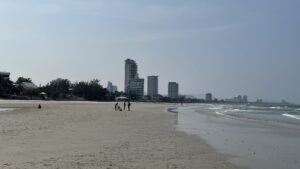
South of Hua Hin, along roughly 60 kilometres of coastline, a temple hill with monkeys, a park with bronze statues of seven kings, a military beach, a weaving village, a mangrove forest and finally a national park with a cave line up one after another — a cave into which daylight has been falling through a natural opening in the rock since 1890.
Khao Takiab — Temple, Monkeys and Fishing Village
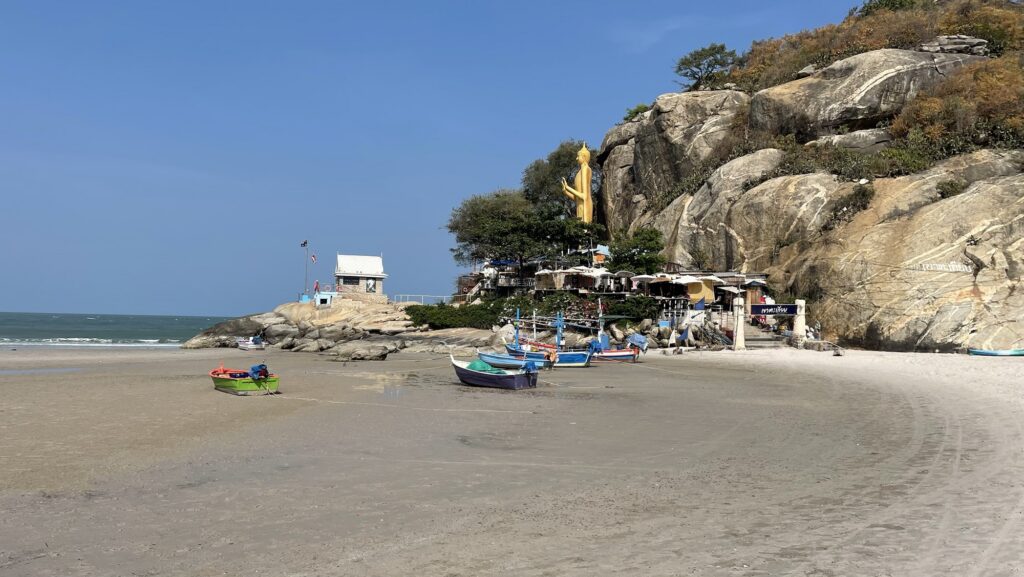
About seven kilometres south of the town centre, Hua Hin’s main beach ends at a hill that juts out into the Gulf of Thailand as a headland. The name means Chopstick Hill, after two parallel rocky spurs at the summit. In English it is also known as Monkey Mountain.
At the top stands Wat Khao Takiab — formally Wat Lad Khao — a Thai-Chinese temple complex that historically served as a landmark for fishing boats. The temple is not architecturally remarkable; what defines it is the blend of Buddhist and Taoist elements typical of coastal temples with a Chinese settlement history. A gilded standing Buddha statue of 20 metres looks out to sea. Several buildings in the complex stand empty and receive no further maintenance.
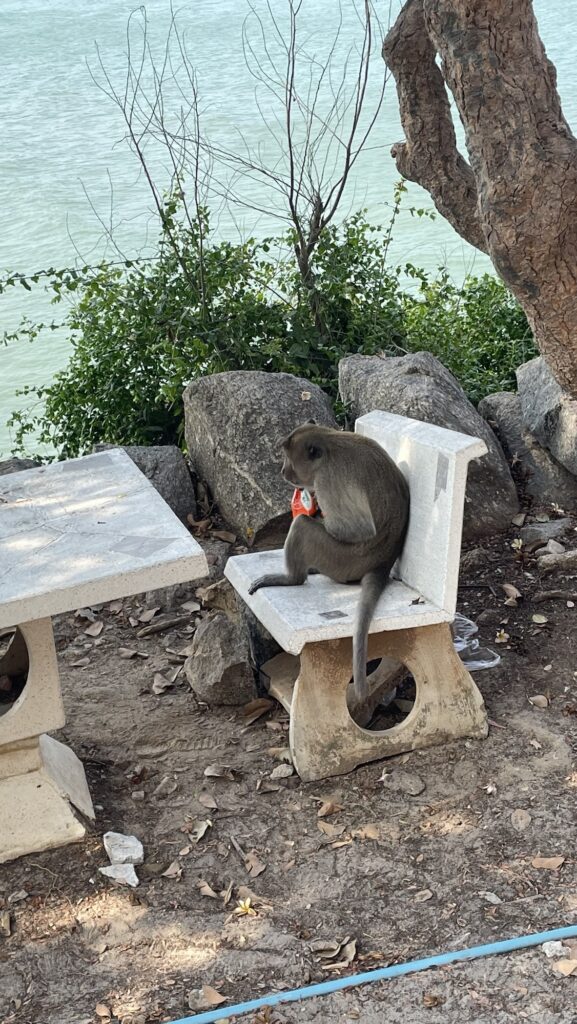
The long-tailed macaques roam across the entire hill. They are accustomed to people, but not tame. Do not carry food, plastic bags or bottles visibly. A designated feeding area exists at the temple.
The ascent is possible on foot via a stairway with Naga reliefs, or by vehicle along a paved road to the car park. The temple opens daily, free of charge.
At the foot of the hill lies a fishing village with harbour and market. Seafood here sells at considerably lower prices than in Hua Hin itself — not a tourist market, but everyday trade. Boats leave from here to the island of Koh Singto off the coast.
The beaches around Khao Takiab are covered in our beach article.
Rajabhakti Park — Seven Kings in Bronze
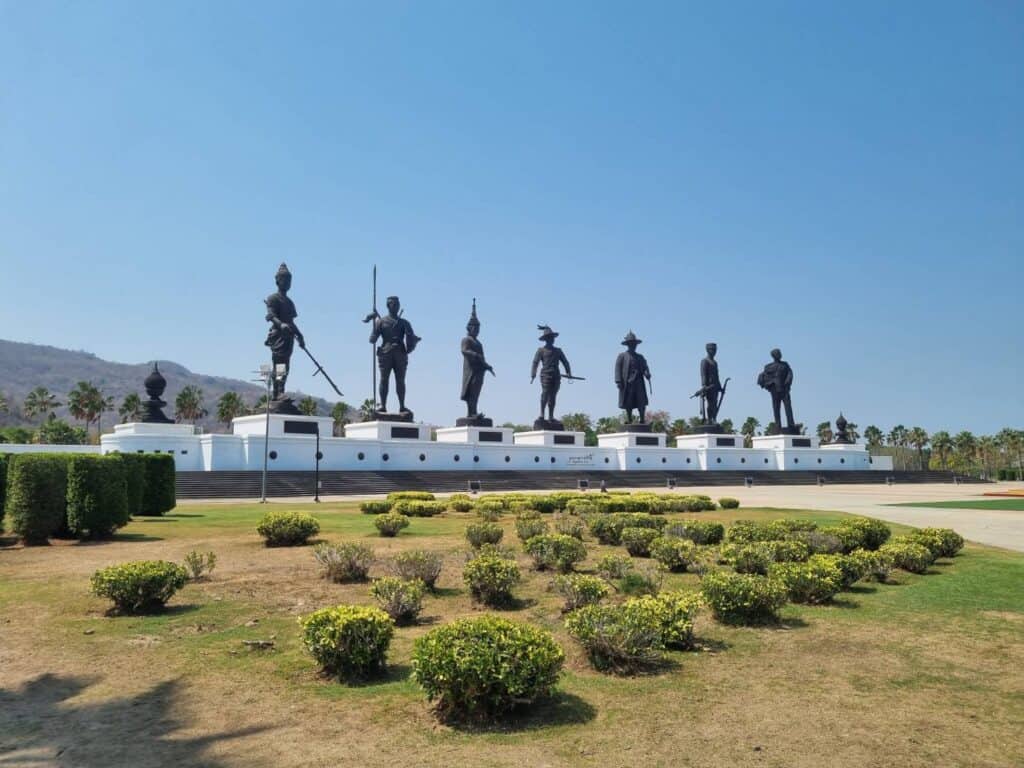
A few kilometres further south of Khao Takiab, on military grounds directly along Phetkasem Road, lies Rajabhakti Park. The Royal Thai Army built it in 2015, funded through public and private contributions, on an area of 222 Rai (approximately 36 hectares). King Bhumibol Adulyadej personally gave the park its name — it means “the park that has been built with people’s loyalty to the monarchs”.
The centrepiece consists of seven bronze statues of historical Thai kings, each between just under 14 and nearly 19 metres tall, arranged in a row against a backdrop of forested hills. The kings represented span four eras: King Ram Khamhaeng from the Sukhothai period, King Naresuan and King Narai from the Ayutthaya period, King Taksin and King Rama I from the Thonburi and early Rattanakosin period, and King Mongkut and King Chulalongkorn. Each statue carries a plaque with name and reign. The Fine Arts Department designed the statues and the Royal Foundry cast them; the process required approximately 150 tonnes of bronze for each.
In addition to the statues, a history museum occupies the base area, and a large open ground hosts military ceremonies and Royal Thai Army parades. Entry is free. However, the grounds offer little shade — a visit in the early morning or late afternoon makes more sense in the heat.
Suan Son Pradipat — Military Beach with Casuarinas
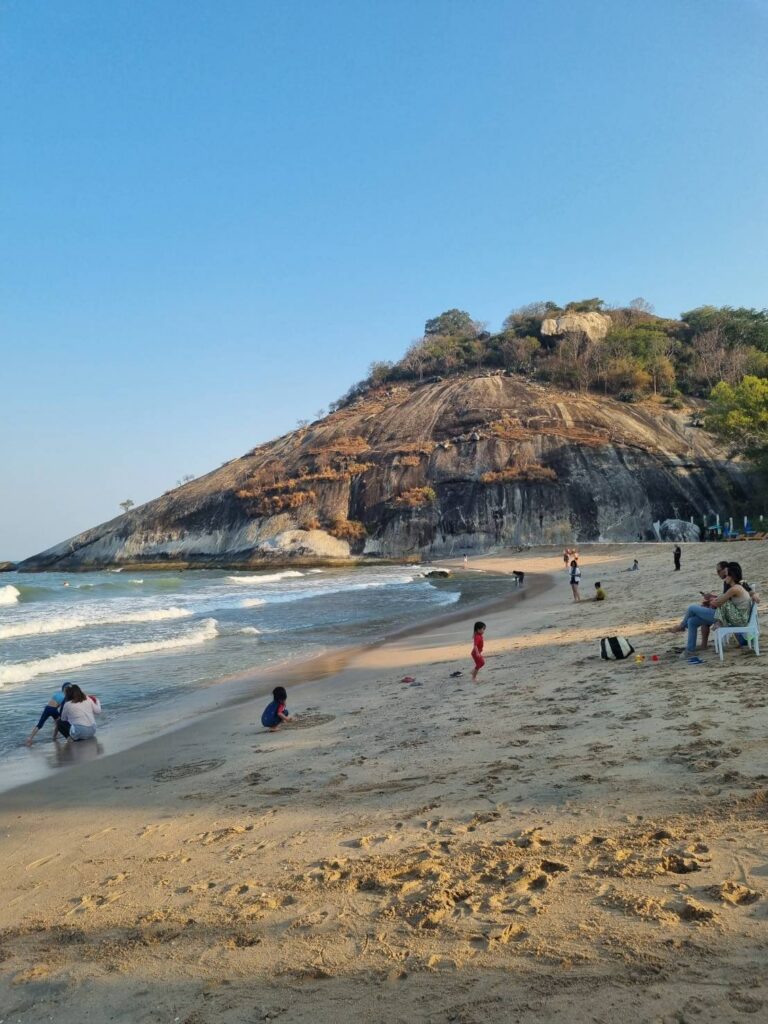
About eight to nine kilometres south of the town centre, Suan Son Pradipat sits on Royal Thai Army grounds. The name means Pine Garden, after the casuarina trees along the coastline. The grounds are open to the public; vehicles pay 10 to 20 Baht entry.
No jet skis, no banana boats. Army families run the restaurants. Sun loungers are available for around 100 Baht. Moreover, at the entrance stands the skeleton of a Bryde’s whale — one of the few publicly accessible whale displays in the region. Within the military grounds there are bungalows and a basic hotel.
Kasetsart University — Veterinary Hospital by the Sea
Directly next to Suan Son, on Phetkasem Road, Kasetsart University operates a Veterinary Teaching Hospital. Thailand’s first agricultural university founded this branch in Hua Hin in 2013 under the patronage of Princess Chulabhorn, herself an alumna of Kasetsart University, which Bangkok established in 1943.
The hospital treats small and large animals and simultaneously serves as a training facility for veterinary students. For travellers with pets, it is the nearest facility with veterinary medical standards.
Khao Tao — Turtle Mountain and Weaving Village
About 15 kilometres south lies Khao Tao — literally: Turtle Mountain. The shape of the hill resembles a turtle lying in the water; the silhouette is clearly visible from the elevated coast.
On the hillside stands Wat Tham Khao Tao, a cave temple with Thai-Chinese influences. Cave chambers contain Buddha figures; a gilded Buddha of about 12 metres stands at the entrance. The temple is not an international tourist destination; the atmosphere reflects this accordingly.
Behind the hill lies a small reservoir — the very first dam project in Thailand, established as a Royal Water Project. Today it is little more than a still body of water between hills, with a shrine on the bank.
In the village itself, the Khao Tao Cotton Weaving Village preserves a traditional craft. A small community still weaves cotton textiles on hand looms. It is not an organised tourist operation; those who walk in see a craft that most parts of Thailand no longer practise.
Pranburi and the Mangrove Forest
Between 20 and 30 kilometres south of Hua Hin lies Pranburi. The former fishing village of Pak Nam Pran has developed into a base for accommodation along this stretch of coast.
A few kilometres further lies Pranburi Forest Park (Wana Utthayan Pran). Queen Sirikit founded this mangrove reforestation project in 1982; it covers just under 3.2 square kilometres. A wooden boardwalk of around one kilometre runs through the forest; an observation tower offers a bird’s-eye view. Furthermore, four kingfisher species are documented in the area. Boat trips through the waterways cost around 400 to 500 Baht. Fireflies appear at dusk. Entry is free. However, no public transport reaches here — a private vehicle is necessary.
Sam Roi Yot — Three Hundred Peaks
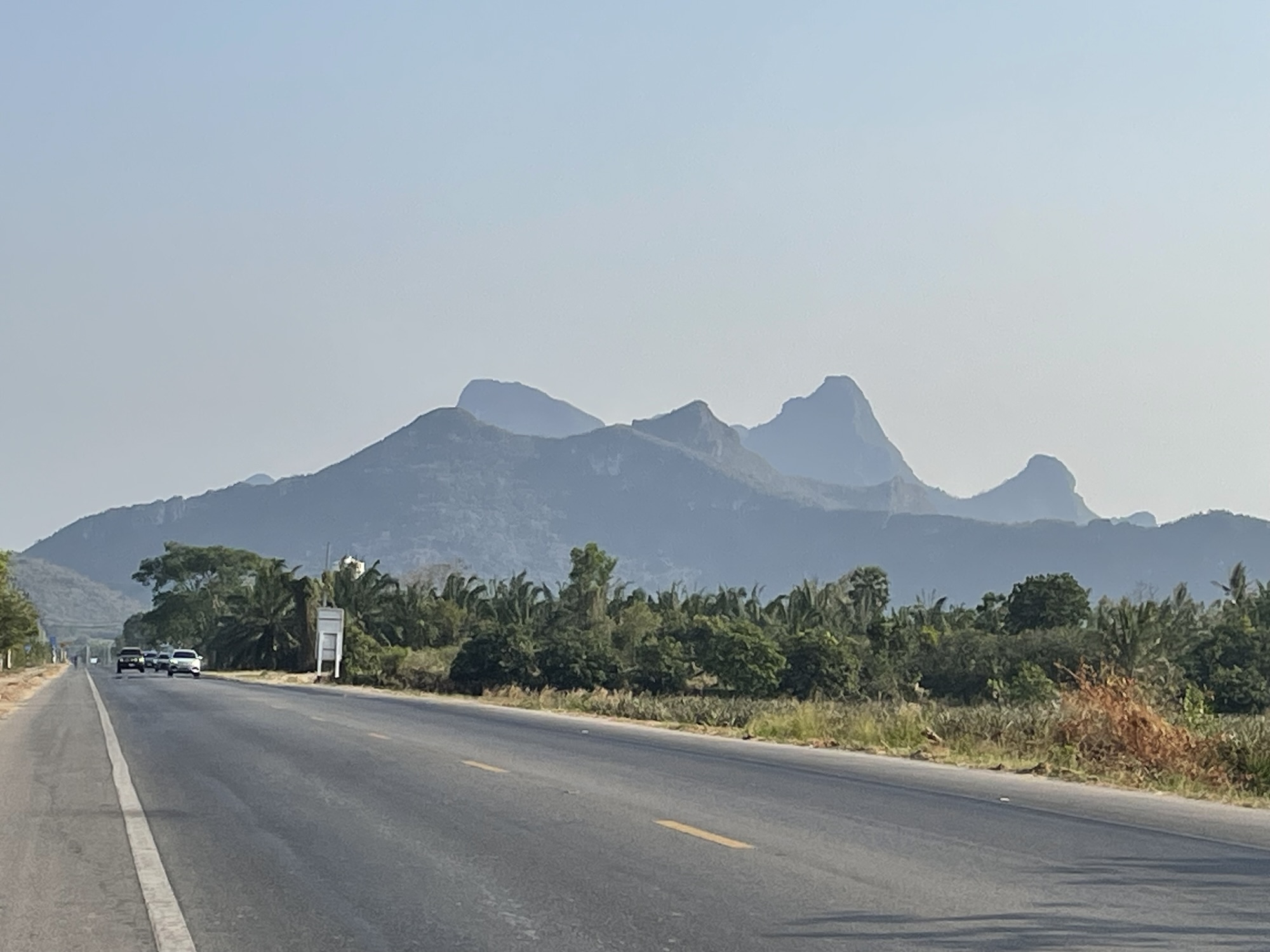
About 60 kilometres south, roughly an hour’s drive, lies Khao Sam Roi Yot National Park. The name means three hundred peaks — a description of the limestone towers that rise here from the flat coastal plain. Thailand established the park in 1966 as its first coastal national park; it covers 98 square kilometres. Entry costs 200 Baht for foreigners.
The best-known destination in the park is Phraya Nakhon Cave. Two chambers with natural openings in the ceiling let daylight into the interior. In the rear section stands the Khuha Kharuehat Pavilion, which workers built in 1890 for King Rama V, who visited the site on an inspection tour and was struck by it. Between 9 and 10:30 in the morning, the light falls directly onto the pavilion.
The cave is accessible from Bang Pu: by boat (around 400 Baht for up to six people) or on foot via Tian Mountain, with a steep final descent of around 430 metres to the cave entrance. Allow two to three hours for the return trip.
Further highlights of the park include 355 documented bird species, Thailand’s largest freshwater marsh, Dusky Langurs on the limestone slopes, and 3,000-year-old cave paintings that researchers discovered in 2020 and have not yet fully studied.
No public transport reaches the park. As a result, a taxi from Hua Hin costs around 1,500 Baht for a return trip.
Distances from Hua Hin Town Centre
| Destination | Distance | Travel time (approx.) |
|---|---|---|
| Khao Takiab | ~7 km | 15–20 min |
| Rajabhakti Park | ~10 km | 15–20 min |
| Suan Son Pradipat / KU Hospital | ~10 km | 15–20 min |
| Khao Tao | ~15 km | ~20 min |
| Pranburi Forest Park | ~25 km | 25–30 min |
| Sam Roi Yot NP | ~60 km | 50–60 min |
Tours & Activities in This Area
Book directly — free cancellation on most tours.